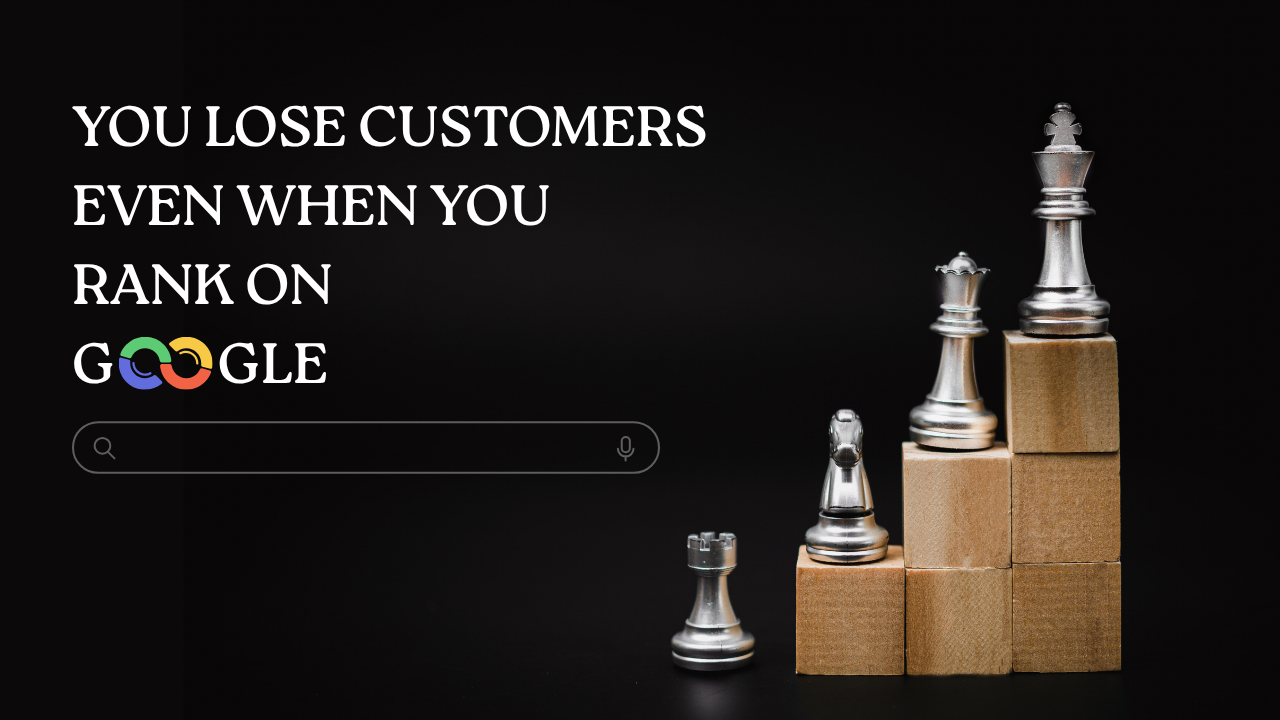
Why Local Businesses Lose Customers Even When They Rank on Google
Introduction
Ranking on Google feels like the finish line.
A local business appears when someone searches for a relevant product or service. The business may even appear prominently in Google Search or Google Maps.
But then something unexpected happens.
The customer doesn't call.
They don't visit the store.
They don't send an enquiry.
They choose another business.
This is one of the most misunderstood problems in local SEO.
Getting visibility is not the same as getting customers.
Google says local results are primarily based on relevance, distance, and prominence, but ranking only determines whether your business can be discovered. What happens after someone discovers you depends on the information, trust, experience, and options your business provides.
So if your local business ranks on Google but isn't generating enough customers, the problem may be happening after the ranking stage.
Ranking Is Only the Beginning of the Customer Journey
Think about what happens when someone searches:
"Furniture shop near me"
They may see several businesses.
Your business appears.
That's good.
But now the customer starts comparing.
They may look at:
- Photos
- Reviews
- Business hours
- Location
- Products
- Website
- Pricing information
- Contact options
- Recent activity
- Overall presentation
The customer doesn't necessarily choose the business that ranks first.
They choose the business that appears to be the best fit for their needs.
This is why local SEO shouldn't be treated purely as a ranking exercise.
Reason 1: Your Listing Doesn't Clearly Explain Why Customers Should Choose You
Imagine two businesses appear next to each other.
Business A:
ABC Furniture
Business B:
XYZ Furniture — Custom Sofas & Modular Furniture
Even before visiting either website, the second business may communicate its offering more clearly.
A customer wants to know:
What does this business sell?
Who is it for?
Where is it located?
Why should I consider it?
Google recommends keeping Business Profile information complete and accurate because this helps Google understand the business and helps customers understand what the business offers.
If your profile is vague, customers may move to a competitor that communicates more clearly.
Reason 2: Your Business Has Poor or Outdated Photos
A customer searching for a local business often wants to know what they're going to experience before visiting.
For a restaurant, that might mean:
- Food
- Interior
- Exterior
- Seating
For a salon:
- Interior
- Work examples
- Team
- Services
For a retailer:
- Store
- Products
- Displays
- Location
If your photos are old, blurry, irrelevant, or extremely limited, your profile may not give customers enough confidence.
Google recommends adding photos that represent the business and help customers understand it.
Reason 3: Your Competitors Have Better Reviews
Two businesses may offer almost identical services.
One has a strong collection of genuine customer feedback.
The other has very few reviews.
A potential customer may naturally feel more comfortable investigating the business with stronger social proof.
But don't interpret this as:
"I need more five-star reviews."
The better lesson is:
"I need to build genuine customer trust."
Google's policies prohibit fake engagement, review incentives, and manipulating review content or ratings.
Real customer experiences are more valuable than artificially inflated ratings.
Reason 4: Your Business Information Is Inconsistent
Imagine someone finds your business on Google.
Your profile says:
Open until 9 PM
Your website says:
Open until 8 PM
Your Instagram says:
Open until 7 PM
Now the customer has to figure out which information is correct.
That creates unnecessary uncertainty.
Important business information should be consistent wherever customers encounter your business.
Pay particular attention to:
- Name
- Address
- Phone number
- Opening hours
- Website
- Services
- Location
A customer shouldn't have to investigate your business just to find out when you're open.
Reason 5: Your Website Is Losing the Customer
This is a major problem.
Your Google listing may be doing its job perfectly.
A customer discovers you.
They click your website.
Then they see:
- Slow-loading pages
- Poor mobile layout
- No clear product information
- Outdated content
- No contact details
- No obvious next step
- Broken links
The customer leaves.
From your perspective:
"Google sent me the customer."
From the customer's perspective:
"This business doesn't seem easy to deal with."
Your website doesn't need to be complicated.
It needs to answer the customer's basic questions quickly.
What do you offer?
Where are you located?
How much does it roughly cost?
How can I contact you?
What should I do next?
Reason 6: Customers Can't Easily Find What They Want
A business might rank for a broad category but fail to provide enough detail about individual products or services.
For example, a customer searches:
"custom wooden dining table in Delhi"
Your business appears for furniture-related searches.
But your online presence doesn't show:
- Dining tables
- Custom options
- Materials
- Sizes
- Designs
- How to enquire
A competitor may provide exactly that information.
The competitor doesn't necessarily need to rank higher.
They simply need to make the customer feel:
"This is what I'm looking for."
This is where relevance becomes more important than visibility alone.
Reason 7: Your Pricing Is Completely Unclear
Not every business needs to publish exact prices.
Some products and services genuinely require a quotation.
But there's a difference between:
"Contact us for a quote."
and
providing absolutely no information about pricing.
Depending on your industry, you can provide useful guidance such as:
- Starting prices
- Price ranges
- Package information
- Factors affecting cost
- What's included
- What's not included
This can reduce uncertainty.
Customers don't necessarily need a final price immediately.
They often need enough information to decide whether contacting you is worth their time.
Reason 8: You Make Customers Work Too Hard to Contact You
Imagine someone wants to ask about a product.
They have to:
- Find your website
- Search for the contact page
- Find your number
- Copy the number
- Open the phone app
- Enter the number
That's unnecessary friction.
If phone calls are important, make calling easy.
If WhatsApp is important, make messaging easy.
If customers visit your store, make directions easy.
The best customer journey reduces the number of unnecessary steps between interest and action.
Reason 9: Your Business Looks Inactiv
A customer may wonder:
"Is this business still operating?"
This can happen when your online presence contains:
- Very old photographs
- Outdated information
- Broken website pages
- Old promotions
- Incorrect hours
- No recent customer activity
An active-looking digital presence doesn't mean posting every day.
It means ensuring that the important information customers depend on is current.
Reason 10: You're Targeting the Wrong Customers
A business can rank well for searches that generate lots of visibility but very little revenue.
For example:
A premium service provider might receive traffic from people searching for cheap alternatives.
A local retailer might appear for searches from customers located too far away.
A B2B company might receive searches from consumers.
The result?
Good visibility. Poor conversion.
This is why businesses should evaluate the quality of traffic, not just the quantity.
Reason 11: Customers Don't Understand Your Difference
Suppose ten businesses offer the same basic service.
If your online presence doesn't communicate what makes you different, customers may simply compare:
Price + Reviews + Distance
That can turn your business into a commodity.
Your differentiation might be:
- Faster delivery
- Customization
- Better selection
- Specialized expertise
- Local availability
- Installation
- After-sales support
- Specific product expertise
You don't need to invent a unique selling proposition.
You need to clearly communicate the real advantages you already provide.
Reason 12: Your Google Presence and Offline Experience Don't Match
This is often overlooked.
Suppose your Google profile shows:
Premium furniture showroom
But customers arrive at a location that looks completely different from what they expected.
Or your profile suggests a particular service that staff members don't actually provide.
This creates a disconnect.
Your online presence should accurately represent the real business.
Google's guidelines emphasize accurate business information and discourage misleading representations.
How to Find Where You're Losing Customers
Instead of guessing, map the customer journey.
Step 1: Discovery
How do customers find you?
Possible sources include:
- Google Search
- Google Maps
- Social media
- Referrals
- Your website
- Direct searches
Step 2: Evaluation
What does the customer see?
Check:
- Reviews
- Photos
- Business information
- Website
- Products
- Services
Step 3: Decision
Why would they choose you instead of another business?
If the answer isn't obvious, your positioning may need work.
Step 4: Contact
Can they easily:
- Call
- Message
- Visit
- Request a quote
- Browse products?
Step 5: Purchase
What happens after the first enquiry?
If the process becomes complicated, you may lose customers even after generating the lead.
What Should a Local Business Improve First?
Don't try to fix everything at once.
Start with the areas most likely to affect customer decisions.
1. Correct your business information
Check your name, address, phone number, hours and website.
2. Improve your profile photos
Use clear, relevant and authentic photographs.
Use clear, relevant and authentic photographs.
3. Explain your products or services
Don't assume customers already know what you offer.
4. Build genuine reviews
Ask real customers for honest feedback without incentives or rating manipulation.
5. Improve your website
Make it easy to understand and navigate on mobile devices.
6. Create a clear next step
Tell customers what they can do next.
7. Track actual enquiries
Don't measure success only through rankings or impressions.
Ranking vs Visibility vs Conversion
These three concepts are often mixed together.
Ranking
Where your business appears for a particular search.
Visibility
How often customers encounter your business.
Conversion
What percentage of those people take a useful action.
You can have:
High ranking + low conversion
or:
Moderate ranking + high conversion
The second situation can be much more valuable to a small business.
This is why local SEO should ultimately connect with business outcomes.
What Metrics Should Local Businesses Watch?
Depending on your business, useful metrics can include:
- Google Business Profile views
- Calls
- Website clicks
- Direction requests
- Messages
- Website enquiries
- Leads
- Store visits
- Sales
Google Business Profile performance reporting includes customer interactions such as calls, website clicks and direction requests, allowing businesses to look beyond visibility alone.
Your own sales and enquiry records then help connect those digital interactions to actual business outcomes.
A Simple Local Conversion Checklist
Before spending more money on SEO, check:
Google Business Profile
☐ Correct business category
☐ Correct phone number
☐ Accurate opening hours
☐ Correct location
☐ Useful description
☐ Relevant services/products
☐ Recent, genuine photographs
Reviews
☐ Genuine customer feedback
☐ Professional responses
☐ No purchased reviews
☐ No incentives for reviews
☐ No pressure for five-star ratings
Website
☐ Mobile-friendly
☐ Clear product/service information
☐ Easy contact options
☐ Accurate business details
☐ Clear next step
Customer Journey
☐ Customer can understand the business quickly
☐ Customer can compare relevant information
☐ Customer can contact you easily
☐ Customer knows what happens next
Frequently Asked Questions
Can a business rank on Google but still get very few customers?
Yes. Ranking provides visibility, but customers still evaluate factors such as relevance, trust, information, convenience and the overall customer experience before taking action.
Why do people choose competitors even when my business ranks higher?
A competitor may provide clearer information, stronger genuine reviews, better photos, more relevant products or services, easier contact options, or a better overall customer experience.
Does Google ranking guarantee more sales?
No. Google ranking and sales are different outcomes. Ranking can help people discover your business, but conversion depends on what happens after discovery.
Should I focus on ranking higher or converting existing visitors?
Both matter, but if your business already receives meaningful visibility, improving conversion can be a more immediate opportunity. More traffic isn't useful if the right customers aren't taking action.
How can I improve my local business conversion rate?
Start by making your business information accurate, improving trust signals, clearly presenting your products or services, making contact easy, and measuring enquiries and sales rather than rankings alone.
Conclusion
Ranking on Google is valuable.
But ranking isn't the same thing as winning the customer.
A local business can appear prominently in Search or Maps and still lose customers because its profile is unclear, its website is weak, its information is outdated, its reviews don't build enough trust, or the customer simply doesn't know what to do next.
The better approach is to think beyond:
"How do I rank?"
and start asking:
"What happens after someone finds me?"
That shift turns local SEO from a visibility exercise into a genuine customer-acquisition strategy.
Your goal isn't just to appear on Google.
It's to make the journey from Google search → trust → enquiry → customer as simple as possible.
How Futkar Can Help
Once a customer discovers your business on Google, Futkar can provide a simple digital destination through a Pocket Website or Online Shop, where customers can learn about your business, explore products or services, and find ways to connect with you. The goal is to make sure your Google visibility has somewhere useful to lead.
Ready to grow your business online?
Create your Pocket Website & Digital VCard free with Futkar.
Start Free Today