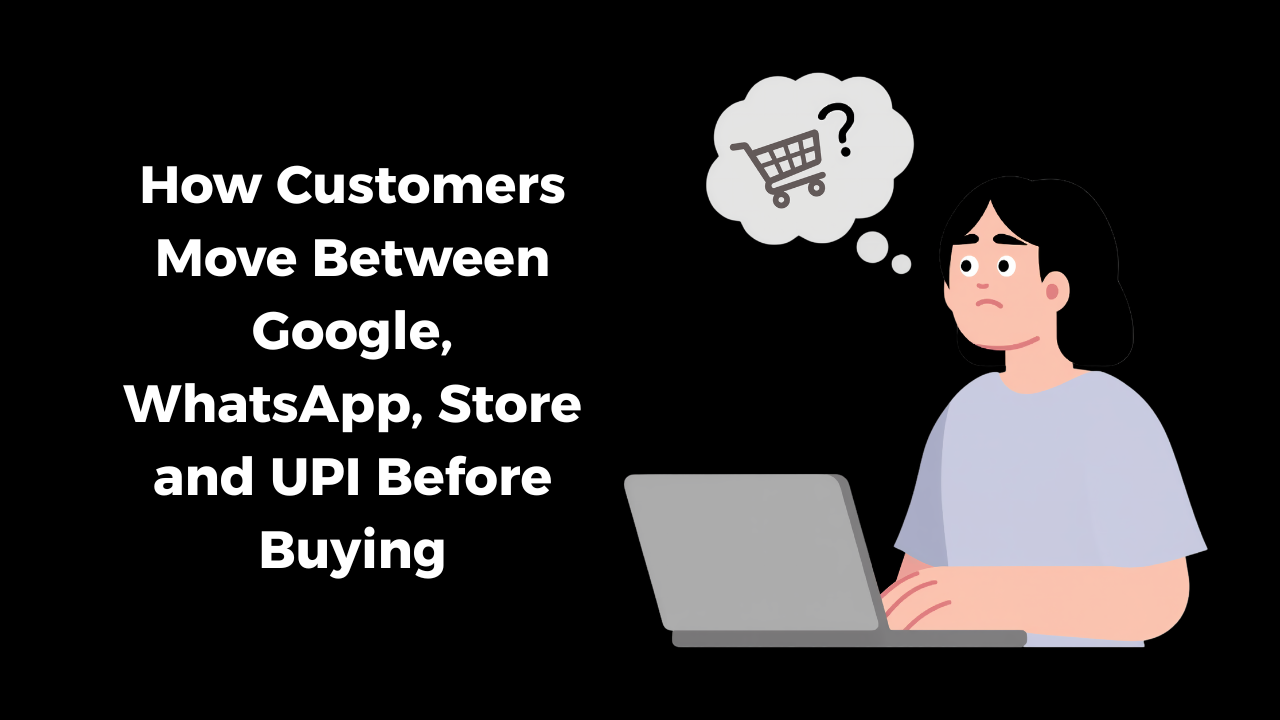
How Customers Move Between Google, WhatsApp, Store and UPI Before Buying
A customer needs a birthday cake. Instead of immediately visiting a bakery, they search on Google, compare nearby options, check photos, and message a shop on WhatsApp to confirm the price. Once satisfied, they visit the store, collect the cake, and pay through UPI.
One purchase, four different customer touchpoints.
This illustrates how the modern customer buying journey works. People often combine online research, direct communication, physical shopping, and digital payments before making a final decision.
For Indian small businesses, understanding these interactions can help improve customer convenience without requiring complicated technology.
1. Google: Where Customers Discover Local Businesses
Many buying journeys begin with a search.
Customers use Google Search or Maps to find nearby shops, compare services, check business hours, and read reviews.
For example, someone searching for "mobile repair shop near me" may explore several businesses before contacting one.
A complete Google Business Profile can help eligible businesses share useful information, including their address, contact details, operating hours, photos, and website.
Small businesses should regularly verify that this information remains accurate.
A wrong phone number or outdated opening time can interrupt the customer journey before a conversation even begins.
2. WhatsApp: Where Customers Ask Questions and Build Confidence
After discovering a business, customers may want more information before visiting or placing an order.
WhatsApp can provide a convenient way to communicate directly.
Common enquiries include:
- Is this product currently available?
- What is the final price?
- Can I see additional product photos?
- Do you offer home delivery?
- Can I collect my order today?
Consider a customer searching for a school bag online. They find a local stationery shop and message the seller to confirm the available colours.
A clear, timely response can help the customer decide whether to visit.
Businesses using WhatsApp Business can also explore features such as business profiles, catalogues, and quick replies, depending on availability.
3. Physical Stores: Where Customers Verify and Experience Products
Online information helps customers narrow their choices, but physical stores remain important for many purchases.
Customers may want to examine product quality, compare sizes, check colours, or speak with a seller before buying.
For example, someone shopping for footwear might discover a design online but prefer trying it on before purchasing.
The transition from digital enquiry to store visit should feel consistent.
If a business confirms that a product is available through WhatsApp, staff should be prepared to assist the customer when they arrive.
Accurate stock information and clear communication help prevent unnecessary disappointment.
4. UPI: Where Customers Complete the Purchase
Once a customer has selected a product, the final step is payment.
UPI allows customers to make supported digital payments directly through participating banking and payment applications.
At a physical store, customers can scan a merchant QR code, verify the recipient details, and authorise payment.
For example, a customer purchasing a ₹750 handbag may prefer paying through UPI rather than carrying cash.
Small businesses can improve this experience by displaying clear QR codes, communicating the correct amount, and confirming successful transactions through trusted banking or merchant applications.
Cash and other suitable payment methods should remain available where practical.
5. The Customer Journey Is Not Always Linear
Customers do not necessarily follow the same sequence every time.
One person might discover a business on Google, visit the store, and later place a repeat order through WhatsApp.
Another might receive a product recommendation from a friend, browse an online catalogue, pay digitally, and collect the product later.
A customer may even compare prices on their phone while standing inside a shop.
This means businesses should not treat online and offline interactions as completely separate activities.
Consistent information across channels makes it easier for customers to move between them.
6. How Small Businesses Can Connect These Touchpoints
Creating a connected buying experience does not always require advanced software.
Start with a few practical improvements:
- Keep Google Business Profile information accurate.
- Provide clear product descriptions and pricing online.
- Make WhatsApp contact details easy to find.
- Respond to customer enquiries consistently.
- Confirm availability before promising products.
- Display accepted payment methods clearly.
- Maintain basic records of customer orders and payments.
For example, a local gift shop can display products through a digital catalogue, answer questions on WhatsApp, and prepare confirmed orders for store collection.
These small improvements reduce the effort customers must make to complete a purchase.
7. Identify Where Customers Drop Off
Not every enquiry results in a sale.
Customers may stop responding because the product is unavailable, prices are unclear, replies are delayed, or payment options are inconvenient.
Businesses can learn from these patterns by reviewing common questions and recurring complaints.
A simple record of customer enquiries, confirmed orders, and completed purchases can reveal useful operational problems.
However, businesses should avoid assuming that every unanswered message represents a lost sale.
The objective is to identify preventable obstacles and improve the overall buying experience.
Frequently Asked Questions (FAQs)
1. What is a customer buying journey?
A customer buying journey describes the steps people take from discovering a product or business to evaluating options, making a purchase, and potentially returning for future purchases.
2. How does Google help local businesses attract customers?
Google Search and Maps help customers discover eligible local businesses and access information such as locations, operating hours, contact details, and customer reviews.
3. Why is WhatsApp useful in the customer buying journey?
WhatsApp allows customers to ask questions, confirm product availability, request information, and coordinate orders before purchasing.
4. How does UPI improve the buying experience?
UPI provides a convenient digital payment option through supported applications, helping customers complete purchases without relying entirely on physical cash.
Conclusion
Today's customer buying journey often connects Google, WhatsApp, physical stores, and UPI. Small businesses that maintain accurate information, respond clearly, and simplify payments can make these transitions more convenient.
Futkar can support online business visibility through Pocket Websites, Online Shops, and Digital VCards, while Google Business Profile, WhatsApp Business, and suitable UPI providers can help manage other parts of the journey.
Ready to grow your business online?
Create your Pocket Website & Digital VCard free with Futkar.
Start Free Today